Going self-employed is exciting – but it can feel like there’s a mountain of admin to climb before you even get started. Whether you’re baking cakes, fixing fences, freelancing online, or just doing the odd job here and there, it’s important to understand what HMRC expects.
Here’s a straightforward guide to registering as self-employed — and what happens once you’ve done it.
Do I Always Need to Register?
Let’s start here – because the answer might surprise you.
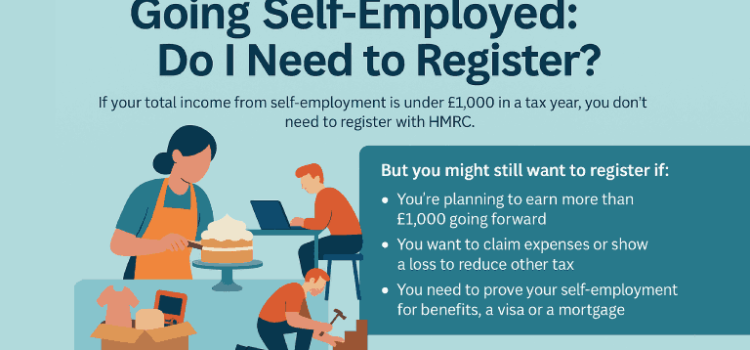
If your total income from self-employment is under £1,000 in a tax year, HMRC gives you something called the trading allowance. That means you don’t need to register, file a tax return, or pay tax on it.
That applies whether you’ve sold a few bits on Etsy, done some weekend garden work, or been paid for a one-off job. Just to be clear: this is different from selling your own personal belongings on platforms like Vinted or eBay. If you’re just clearing out items you already own – clothes, electronics, furniture – that’s not considered income, and you can sell as much as you like without needing to register.
But – and it’s a big but – you might still want to register if:
- You’re planning to earn more than £1,000 going forward
- You want to claim expenses or show a loss to reduce other tax
- You need to prove your self-employment for benefits, a visa or a mortgage
So, if you’re just dabbling – no action needed. But if you’re planning to turn this into something more regular, or you’re already past the £1,000 mark, here’s what to do next.
How to Register with HMRC
It’s free. It’s all online. And it’s (mostly) straightforward.
Here’s what you do:
- Go to gov.uk/register-for-self-assessment
- Choose the option that says “I’m self-employed”
- Set up a Government Gateway account if you haven’t already
- Fill in the details they ask for (name, date of birth, National Insurance number, start date, etc.)
- Wait for your UTR (Unique Taxpayer Reference) to arrive by post
That’s it. Once you’re set up, HMRC will expect you to do a Self Assessment tax return every year. Your first one will usually be due by 31 January after the end of the tax year.
So if you start trading in July 2025, you’ll need to file your first return by 31 January 2027.
What Happens Next?
Registering is just the first step. Here’s what else you’ll want to get sorted early on:
1. Start Keeping Records
You’ll need to keep track of what you earn and what you spend. This doesn’t need to be anything fancy – a spreadsheet will do just fine (as long as your self-employed income stays under the Making Tax Digital threshold, which is £50,000 from the 2026/27 tax year).
If you’d rather go digital, accounting software can make things easier — especially as you grow.
However you do it, just make sure you’re recording:
- Income (sales, invoices, cash payments)
- Expenses (tools, stock, fuel, software, phone, etc.)
- Mileage or business use of your vehicle (if relevant)
2. Set Aside Money for Tax
A good rule of thumb is to put aside 20% of your income as you go. That way, you’re not scrambling for cash when the tax bill lands.
3. Know the Deadlines
- 5 October after the end of your first tax year: deadline to register
- 31 January: file your return and pay your tax bill
4. Understand National Insurance
You’ll pay Class 4 NIC through your tax return — 6% on profits between £12,570 and £50,270, and 2% above that. If your profits are under £6,725, you might want to pay Class 2 NIC voluntarily to protect your State Pension — feel free to ask if you’re unsure.
Common Questions
Can I be employed and self-employed at the same time?
Yes – loads of people are. You’ll pay PAYE on your employed income, and Self Assessment covers the rest.
Do I need a separate bank account?
It’s not compulsory, but it makes life much easier come tax time. Keeps things clean. Consider Starling, who offer free business bank accounts.
Can I claim for equipment or tools?
Yes – if it’s used for your business, it’s likely allowable. That includes phones, laptops, tools, software, office supplies, and more. Just double check that you are claiming a fair amount.
What if I don’t earn anything in one year?
Still file your tax return – just put in zero income. No penalties if it’s on time.
Want to Get It Right From Day One?
I speak to lots of people who wait too long to get help, then spend weeks untangling things that could’ve been simple.
If you’re just starting out and want to make sure you’ve got everything in order – or if you’ve been going a while and just want a sense-check — I’m always happy to have a quick chat.
Just drop me a message. No jargon.