If you are self-employed and your profits are increasing, you may have started wondering whether it is time to set up a limited company.
For years, the usual advice was that a limited company became worthwhile once profits reached around £30,000 or £40,000.
That rule of thumb is now out of date.
Dividend tax rates increased from 6 April 2026, while companies must also consider corporation tax and employer’s National Insurance on a director’s salary.
So where is the new tipping point?
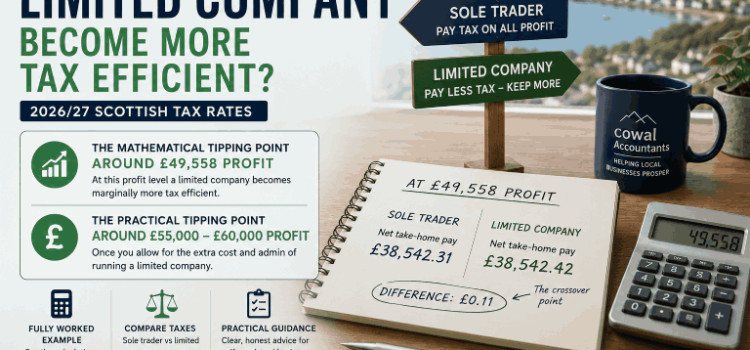
For a Scottish taxpayer in the 2026–27 tax year, our calculations suggest that the first tax crossover occurs at approximately:
£49,558 of Annual Profit
At that point, a limited company becomes very slightly more tax efficient than operating as a sole trader.
But there is an important word in that sentence.
Slightly.
At £49,558 of profit, the calculated advantage is only around 11p.
That does not mean someone earning £49,558 should immediately form a company. It simply shows the mathematical point at which the two calculations cross.
The practical point at which incorporation becomes worthwhile is normally higher.
What Assumptions Have We Used?
The calculation assumes:
- the taxpayer lives in Scotland;
- there is no other income;
- the tax year is 2026–27;
- the business profit is calculated before the director’s salary and employer’s National Insurance;
- the company pays the director a salary of £12,570;
- the company cannot claim the Employment Allowance;
- the remaining company profit is withdrawn as a dividend;
- there are no pension contributions;
- the company has no associated companies;
- the owner takes all available profits personally.
The Scottish income-tax bands apply to sole-trader profits and salary. Dividends are taxed using the UK dividend rates.
For 2026–27, the Scottish higher rate of 42% begins once income exceeds £43,662. The ordinary dividend rate is 10.75%, the upper dividend rate is 35.75%, and the dividend allowance remains £500. Corporation tax is 19% where taxable company profits do not exceed the small-profits limit. These rates are correct for the 2026–27 tax year.
Sole Trader Calculation at £49,558 Profit
Let us first look at the sole-trader position using exactly £49,558 of profit.
Personal Allowance
The standard Personal Allowance is:
£12,570
This leaves taxable income of:
£49,558 − £12,570 = £36,988
Scottish Starter-Rate Tax
The first £3,967 of taxable income is charged at 19%:
£3,967 × 19% = £753.73
Scottish Basic-Rate Tax
The next £12,989 is charged at 20%:
£12,989 × 20% = £2,597.80
Scottish Intermediate-Rate Tax
The next £14,136 is charged at 21%:
£14,136 × 21% = £2,968.56
Scottish Higher-Rate Tax
The remaining income is above the Scottish higher-rate threshold.
£49,558 − £43,662 = £5,896
This is charged at 42%:
£5,896 × 42% = £2,476.32
Total Scottish Income Tax
£753.73
- £2,597.80
- £2,968.56
- £2,476.32
= £8,796.41
Class 4 National Insurance
Class 4 National Insurance is charged at 6% on profits between £12,570 and £50,270.
£49,558 − £12,570 = £36,988
£36,988 × 6% = £2,219.28
Sole-Trader Take-Home Pay
£49,558
− £8,796.41 income tax
− £2,219.28 Class 4 National Insurance
= £38,542.31
The sole trader therefore keeps:
£38,542.31
Limited Company Calculation at £49,558 Profit
We will now use the same starting profit of £49,558 for the limited company.
The company pays the director a salary of £12,570.
That salary is an expense of the company and is deducted before corporation tax is calculated.
Director’s Salary
Gross salary:
£12,570
The salary is covered by the director’s Personal Allowance, so no personal income tax is due.
It does not exceed the employee National Insurance primary threshold, so no employee National Insurance is due either.
Employer’s National Insurance
The company pays employer’s National Insurance at 15% on salary above the £5,000 secondary threshold.
£12,570 − £5,000 = £7,570
£7,570 × 15% = £1,135.50
The employer’s National Insurance is also an allowable company expense.
Company Profit Subject to Corporation Tax
Starting business profit:
£49,558
Less director’s salary:
£12,570
Less employer’s National Insurance:
£1,135.50
Taxable company profit:
£49,558 − £12,570 − £1,135.50 = £35,852.50
Corporation Tax
The company’s taxable profit is below £50,000, so corporation tax is calculated at 19%.
£35,852.50 × 19% = £6,811.98
Dividend Available
The remaining post-tax company profit can be paid to the shareholder as a dividend.
£35,852.50 − £6,811.98 = £29,040.52
Dividend Tax
The director’s £12,570 salary has used the full Personal Allowance.
The first £500 of the dividend falls within the dividend allowance.
£29,040.52 − £500 = £28,540.52
This dividend remains within the ordinary dividend-rate band and is charged at 10.75%.
£28,540.52 × 10.75% = £3,068.11
Limited-Company Take-Home Pay
Salary received:
£12,570
Dividend received:
£29,040.52
Less dividend tax:
£3,068.11
Total take-home:
£12,570 + £29,040.52 − £3,068.11 = £38,542.41
Depending on whether tax is rounded at each stage or only at the end of the calculation, the result may differ by a penny.
The company owner therefore keeps approximately:
£38,542.42
The Actual Difference
At the same starting profit of £49,558:
| Structure | Net take-home |
|---|---|
| Sole trader | £38,542.31 |
| Limited company | £38,542.42 |
| Limited-company advantage | £0.11 |
That is the mathematical crossing point.
But nobody should set up a limited company to save 11p.
Why a Limited Company Can Still Make Sense Earlier
A company may still be appropriate below the tax crossover where:
- the business carries meaningful financial or contractual risk;
- customers expect to deal with a limited company;
- the owner wants to bring in another shareholder;
- profits will be retained rather than withdrawn;
- the company will make employer pension contributions;
- the business may eventually be sold;
- the owner wants a clearer separation between personal and business finances.
Keeping profits inside the company can make a particularly important difference.
A sole trader pays income tax and National Insurance on the full annual profit, whether the money is spent personally or left in the business bank account.
A company initially pays corporation tax on its profits. Personal dividend tax is normally due only when money is extracted.
That can make a company more attractive where the owner does not need to withdraw everything.
Thinking About Going Limited?
If your profits are approaching £50,000 or more, it is worth reviewing the position before the end of the tax year.
At Cowal Accountants, we can compare the sole-trader and limited-company positions using your actual business profits, personal income and expected withdrawals.
That gives you a decision based on your own figures rather than an outdated rule of thumb.
Contact Cowal Accountants to discuss whether becoming a limited company is genuinely worthwhile for your business.